

Last Updated: July 2026 | This guide reflects the Inland Revenue Act No. 24 of 2017 (as amended by the Inland Revenue (Amendment) Act, No. 2 of 2025) and IRDInland Revenue Department — Sri Lanka's tax authority Public Notice PN/IT/2025-01. Tax rates verified against IRD official publications.
What You'll Learn in This Definitive Tax Guide
Whether you're a salaried employee, freelancer, or business owner, understanding Sri Lanka's income tax system is essential for financial planning. → Jump straight to your numbers: Income Tax Calculator This comprehensive guide covers:
- Current tax brackets and rates for the active 2025/2026 assessment year
- Step-by-step calculations with real salary examples (Rs. 125K to Rs. 400K+)
- Reliefs and Schedule-5 qualifying payments — what actually reduces your taxable income
- APITAdvance Personal Income Tax — income tax withheld on employment income (Advance Personal Income Tax) explained — how your employer withholds tax each month
- Critical deadlines and how to avoid penalties
- 2025/2026 key changes effective from April 1, 2025
Why trust this guide? We reference the official Inland Revenue Department, the Inland Revenue Act, and IRDInland Revenue Department — Sri Lanka's tax authority Public Notice PN/IT/2025-01.
Quick Summary: 2025/2026 Tax Year
| Key Information | Details |
|---|---|
| Tax Year | April 1, 2025 – March 31, 2026 |
| Tax-Free Threshold | Rs. 1,800,000 per year |
| Monthly Equivalent | Rs. 150,000 per month |
| Maximum Tax Rate | 36% |
| Filing Deadline | November 30, 2026 |
| Payment Deadline | September 30, 2026 |
These thresholds and rates are in force for the 2025/2026 year of assessment.
Understanding Tax Brackets
Sri Lanka uses a progressive tax system. Higher income is taxed at higher rates, but only the portion above each threshold.
The rates below apply to taxable income after subtracting:
- Personal relief (Rs. 1,800,000/year)
- Rent relief (25% of investment rental income) and solar relief (up to Rs. 600,000/year for resident grid-connected installations)
- Schedule-5 qualifying payments — e.g. approved charity donations capped at the lower of the donation, Rs. 75,000, or one-third of taxable income
EPFEmployees' Provident Fund — mandatory retirement savings fund for private-sector workers is not a tax deduction. Your 8% employee EPFEmployees' Provident Fund — mandatory retirement savings fund for private-sector workers contribution is a payroll deduction — it reduces take-home pay, never taxable income.
Current Tax Rates (2025/2026)
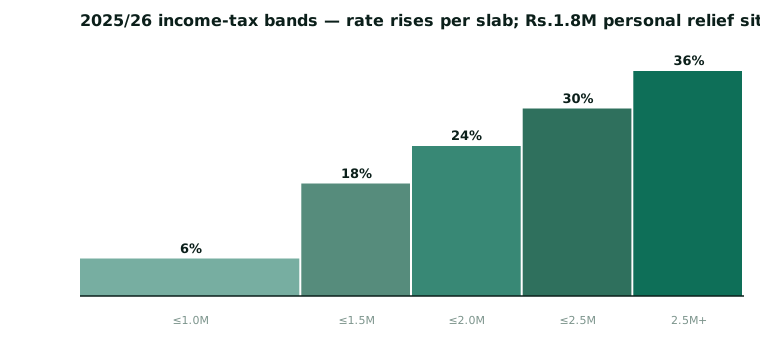
| Annual Taxable Income Slab | Tax Rate | Tax on Slab | Cumulative Tax |
|---|---|---|---|
| 0 - 1,000,000 | 6% | Rs. 60,000 | Rs. 60,000 |
| 1,000,001 - 1,500,000 | 18% | Rs. 90,000 | Rs. 150,000 |
| 1,500,001 - 2,000,000 | 24% | Rs. 120,000 | Rs. 270,000 |
| 2,000,001 - 2,500,000 | 30% | Rs. 150,000 | Rs. 420,000 |
| Above 2,500,000 | 36% | Varies | Varies |
(Rs. 1,000,000 = 1 million; Rs. 2,000,000 = 2 million; and so on.)
Visual Breakdown
Taxable Income Level    Tax Rate
━━━━━━━━━━━━━━━━━━━━━━━━━━━━━━━━━━
0 - 1,000,000          ▓░░░░░  6%
1,000,000 - 1,500,000  ▓▓░░░░  18%
1,500,000 - 2,000,000  ▓▓▓░░░  24%
2,000,000 - 2,500,000  ▓▓▓▓░░  30%
Above 2,500,000        ▓▓▓▓▓▓  36%
Real-World Examples
Example A: Entry-Level Professional
Situation: Kavindi is a marketing executive earning Rs. 120,000/month.
Calculation:
- Annual salary: Rs. 120,000 × 12 = Rs. 1,440,000/year (1.44 million)
- Less personal relief: Rs. 1,800,000
- Taxable income: Rs. 0 (personal relief exceeds salary)
Tax Calculation:
- Annual tax: Rs. 0
- Monthly tax: Rs. 0/month
Effective tax rate: 0%
Example B: Mid-Career Manager
Situation: Ruwan is an IT manager earning Rs. 260,000/month.
Calculation:
- Annual salary: Rs. 260,000 × 12 = Rs. 3,120,000
- Less personal relief: Rs. 1,800,000
- Taxable income: Rs. 1,320,000 (1.32 million)
Tax Calculation:
| Slab | Amount | Rate | Tax |
|---|---|---|---|
| First 1,000,000 | Rs. 1,000,000 | 6% | Rs. 60,000 |
| Next 500,000 | Rs. 320,000 | 18% | Rs. 57,600 |
| Total | Rs. 117,600 |
Monthly average: Rs. 117,600 ÷ 12 = Rs. 9,800/month (indicative annual average — your payslip shows APITAdvance Personal Income Tax — income tax withheld on employment income per IRDInland Revenue Department — Sri Lanka's tax authority Table 01)
Effective tax rate: 3.8%
Example C: Senior Executive with Reliefs
Situation: Dilshan earns Rs. 400,000/month and has:
- Grid-connected solar installation expenditure: Rs. 800,000 (resident)
- Approved charity donations: Rs. 100,000/year
Calculation:
- Annual salary: Rs. 400,000 × 12 = Rs. 4,800,000
- Less personal relief: Rs. 1,800,000
- Less solar relief (capped): Rs. 600,000
- Less charity QP: Rs. 75,000 (the lower of the donation, Rs. 75,000, or ⅓ of taxable income before qualifying payments)
- Taxable income: Rs. 2,325,000
Tax Calculation:
| Slab | Amount | Rate | Tax |
|---|---|---|---|
| First 1,000,000 | Rs. 1,000,000 | 6% | Rs. 60,000 |
| Next 500,000 | Rs. 500,000 | 18% | Rs. 90,000 |
| Next 500,000 | Rs. 500,000 | 24% | Rs. 120,000 |
| Remaining | Rs. 325,000 | 30% | Rs. 97,500 |
| Total | Rs. 367,500 |
Monthly average: Rs. 367,500 ÷ 12 = Rs. 30,625/month (indicative annual average — not APITAdvance Personal Income Tax — income tax withheld on employment income withholding)
Effective tax rate: 7.66%
Without reliefs, taxable income would be Rs. 3,000,000 and tax would be Rs. 570,000. Savings: Rs. 202,500.
Tax Deductions You Can Claim
Summary of Reliefs & Qualifying Payments (Y/A 2025/26)
| Relief / QP | Limit | Notes |
|---|---|---|
| Personal Relief | Rs. 1,800,000 | Residents only; automatic |
| Rent Relief | 25% of rental income | Investment rental income |
| Solar Relief | Rs. 600,000/yr | Resident, grid-connected installations |
| Charity Donations (Sched. 5) | Lower of donation, Rs. 75,000, or ⅓ of taxable income | Approved charities with receipts |
| Other Schedule-5 QPs | Per Schedule 5 | See IRDInland Revenue Department — Sri Lanka's tax authority return guide |
There is no combined Rs. 1 million cap and no deduction for life/health insurance or housing-loan interest under the Y/A 2025/26 return structure — those items were removed from the deduction schedule.
How EPF Really Works
Your Employees' Provident Fund (EPFEmployees' Provident Fund — mandatory retirement savings fund for private-sector workers) contribution — 8% of salary — is a payroll deduction — it comes out of your take-home pay, not your taxable income. APITAdvance Personal Income Tax — income tax withheld on employment income Table 01 computes monthly withholding on employment profits without deducting EPFEmployees' Provident Fund — mandatory retirement savings fund for private-sector workers.
Example: Rs. 200,000 salary
- EPFEmployees' Provident Fund — mandatory retirement savings fund for private-sector workers payroll deduction: Rs. 16,000 (take-home impact only)
- Taxable income for annual tax: still Rs. 200,000 × 12 − Rs. 1,800,000 relief
👉 Learn more: EPF & ETF Tax Benefits Guide
APIT: How Your Employer Deducts Tax
APITAdvance Personal Income Tax — income tax withheld on employment income (Advance Personal Income Tax) is the system where your employer withholds tax from your salary each month.
How APIT Works
- Employer estimates your annual income
- Applies tax brackets to calculate annual tax
- Divides by 12 for monthly deduction
- Remits to IRDInland Revenue Department — Sri Lanka's tax authority by the 15th of the following month
APIT Monthly Brackets (2025/2026)
| Monthly Salary (Rs.) | Tax Rate |
|---|---|
| 0 - 150,000 | 0% |
| 150,001 - 233,333 | 6% |
| 233,334 - 316,667 | 18% |
| 316,668 - 400,000 | 24% |
| 400,001 - 483,333 | 30% |
| 483,334+ | 36% |
These bands are the IRDInland Revenue Department — Sri Lanka's tax authority monthly APITAdvance Personal Income Tax — income tax withheld on employment income withholding thresholds published under PN/IT/2025-01. The first band reflects the monthly personal relief of Rs. 150,000.
What to Check on Your Payslip
- Gross Salary: Your full salary before deductions
- EPFEmployees' Provident Fund — mandatory retirement savings fund for private-sector workers (8%): Employee contribution to provident fund
- APITAdvance Personal Income Tax — income tax withheld on employment income: Tax amount deducted
- Net Salary: Amount you receive
Common APIT Issues
| Problem | Cause | Solution |
|---|---|---|
| Too much tax deducted | Employer overestimated income | Submit Form T10 with deductions |
| Too little deducted | Multiple jobs or freelance income | File return and pay difference |
| Wrong calculations | Outdated tax tables | Report to HR department |
👉 Learn more: APIT Explained in Detail
Filing Your Tax Return
Who Must File?
You must file a return if:
- ✅ Total income exceeds Rs. 1,800,000/year
- ✅ You have income from multiple sources
- ✅ You have rental income
- ✅ You have capital gains
- ✅ You want to claim a refund
- ✅ IRDInland Revenue Department — Sri Lanka's tax authority sends you a notice
You don't need to file if all of the following are true (per IRDInland Revenue Department — Sri Lanka's tax authority Notice PN/IT/2026-02):
- ❌ Your only income is employment income on which APITAdvance Personal Income Tax — income tax withheld on employment income was deducted
- ❌ You have no instalment or final balance payable (≤ Rs. 5,000 interest excepted)
- ❌ No IRDInland Revenue Department — Sri Lanka's tax authority file was previously opened in your name (an already-open file continues until formally closed)
Important Deadlines
| Deadline | Action | Penalty for Missing |
|---|---|---|
| November 30 | File annual return | Greater of (5% of tax + 1%/month) or (Rs. 50,000 + Rs. 10,000/month) per IRDInland Revenue Department — Sri Lanka's tax authority return guide |
| September 30 | Pay final tax balance | 20% penalty + 1.5%/month interest on unpaid tax |
| Quarterly | Instalment payments (self-employed) | 10% penalty on missed instalment |
| Ongoing | Keep records for 5 years | Audit complications |
How to File
- Register for TINTaxpayer Identification Number — your IRD registration number needed to file returns at ird.gov.lk
- Login to the e-Services portal
- Complete Form T1 (Individual Return)
- Attach supporting documents
- Submit electronically
- Pay any balance via bank transfer
Tax Planning Tips
Maximize Your Reliefs & Qualifying Payments
- Charity donations – Approved charities count up to the lower of the donation, Rs. 75,000, or ⅓ of taxable income
- Solar panels – Up to Rs. 600,000/yr relief on qualifying grid-connected installations (residents)
- Rent relief – 25% of investment rental income if you let out property
- Schedule-5 QPs – Check the IRDInland Revenue Department — Sri Lanka's tax authority return guide for the full qualifying-payment list
Timing Strategies
- Make qualifying donations before March 31
- Submit Form T10 early for adjusted APITAdvance Personal Income Tax — income tax withheld on employment income
Multiple Income Sources
If you have:
- Freelance income
- Rental income
- Interest income
- Business income
You must file a return and may need to pay quarterly installments.
Common Mistakes to Avoid
| Mistake | Impact | Prevention |
|---|---|---|
| Not filing when required | Rs. 50,000+ late-filing penalty (or 5% of tax + 1%/month, whichever is greater) | File by November 30 |
| Missing payment deadline | 20% penalty + 1.5%/month interest | Pay by September 30 |
| Missing an instalment | 10% penalty on the missed instalment | Pay quarterly on time |
| Not claiming reliefs | Overpaying tax | Review Schedule-5 QPs |
| Wrong TINTaxpayer Identification Number — your IRD registration number needed to file returns | Return rejected | Double-check your number |
| Not keeping records | Audit problems | Save all documents 5 years |
Key Changes for 2025/2026
The active 2025/2026 tax year introduced the following from April 1, 2025:
| Change | 2025/2026 Value |
|---|---|
| Tax-free threshold | Rs. 1,800,000/year |
| First tax slab | Up to Rs. 1,000,000 taxable @ 6% |
| Second tax slab | Rs. 1,000,001 - 1,500,000 @ 18% |
| Third tax slab | Rs. 1,500,001 - 2,000,000 @ 24% |
| Fourth tax slab | Rs. 2,000,001 - 2,500,000 @ 30% |
| Top rate | Above Rs. 2,500,000 @ 36% |
Impact: Lower tax for most employees. Someone earning Rs. 150,000/month pays zero tax because the Rs. 1.8M personal relief covers the full Rs. 1.8M annual salary.
Official Resources
- Inland Revenue Department: ird.gov.lk
- IRDInland Revenue Department — Sri Lanka's tax authority Public Notice PN/IT/2025-01: IRD Notices
- Inland Revenue (Amendment) Act, No. 2 of 2025: Parliament.lk
- Budget 2025 Proposals: treasury.gov.lk
- Inland Revenue Act No. 24 of 2017: Parliament.lk
Calculate Your Tax Now
Don't guess your tax liability. Use our free calculator for accurate results.
Enter your income, deductions, and get:
- Exact tax amount
- Monthly breakdown
- Tax bracket visualization
- Comparison with/without deductions
Related Guides
- APIT Explained: How Employer Tax Deduction Works
- Tax Deductions in Sri Lanka 2026
- Expat & Remote Worker Tax Guide
- EPF & ETF Tax Benefits
Frequently Asked Questions
"Do I pay tax on my entire salary?"
No. Only income above Rs. 1,800,000/year is taxed. The first Rs. 1,800,000 is the personal relief or tax-free threshold.
"Does EPF reduce my taxable income?"
No. Your 8% EPFEmployees' Provident Fund — mandatory retirement savings fund for private-sector workers contribution is a payroll deduction — it reduces take-home pay, not taxable income. APITAdvance Personal Income Tax — income tax withheld on employment income Table 01 computes employer withholding on employment profits without deducting EPFEmployees' Provident Fund — mandatory retirement savings fund for private-sector workers. Learn more in our EPF & ETF Tax Benefits Guide.
"Can I get a refund if I overpaid?"
Yes. File your annual return through the IRD e-Services portal and apply for a refund. Processing typically takes 3-6 months.
"What if I changed jobs mid-year?"
Get your APITAdvance Personal Income Tax — income tax withheld on employment income certificate (Form T2) from your old employer and provide it to your new employer for correct calculations. Read our detailed APIT Explained Guide for the full process.
"I earn from freelancing and salary. How am I taxed?"
Both income sources are combined for tax calculation. You must file an annual return and may need to pay quarterly installments. See our Expat & Remote Worker Tax Guide for more details.
"What happens if I don't file my return?"
You face a penalty of Rs. 50,000 plus monthly interest on unpaid tax. The IRDInland Revenue Department — Sri Lanka's tax authority can also issue assessments based on their estimates, which may be higher than your actual liability.
Read: Related Guides
This article is part of our comprehensive Tax Education Hub. Explore related topics:
| Guide | What You'll Learn | Read Time |
|---|---|---|
| APIT Explained | How employer tax deductions work | 12 min |
| Tax Deductions 2026 | Reliefs & Schedule-5 qualifying payments | 10 min |
| Expat & Remote Worker Tax | 183-day rule, foreign income | 11 min |
| EPF/ETF Tax Benefits | Triple tax advantage explained | 9 min |
Disclaimer
This guide is for educational purposes and reflects tax laws as of July 2026. Tax rules change frequently. Always verify with the Inland Revenue Department or consult a qualified tax professional for advice specific to your situation.
Last Updated: July 1, 2026
Sources: